Nobody Taught You That Being Nice Would Cost You This Much
A 5-Day Protocol to Stop Losing Money to Clients Who Take Advantage of Your Kindness


She asked for a discount and you said yes before the sentence was finished. You didn't think about it. You didn't calculate. You didn't pause. Your mouth opened and the word came out the way it always does: automatically, reflexively, from a place so deep inside you that by the time your brain caught up, the price had already dropped by N15,000 and the client was smiling and you were smiling too, except your smile was the kind that aches behind the teeth because you know what just happened. You just paid for her comfort with your income. Again.
The discount.
It is not a business decision. It is a reflex. The same reflex that says "no problem" when the client adds work outside the scope. The same reflex that says "I can do that" when the brief changes for the third time without additional payment. The same reflex that says "take your time" when the invoice is 6 weeks overdue and you need the money for rent.
You are not running a business. You are running a charity with invoices.
"I am 34 years old. I am a freelance brand designer in Lagos. I am good at what I do. My portfolio is strong. My clients come back. But they come back because I am cheap and accommodating, not because they respect my value. I have given discounts I was never asked for because I was afraid the price would scare them away. I have done free revisions that took 8 hours because I was afraid of being called 'difficult.' I have waited 3 months for payment because I was afraid that chasing the invoice would damage the relationship."
"In 2 years, I estimate I have lost over N400,000 to undercharging, scope creep, and unpaid invoices. Not because my work wasn't worth it. Because I cannot say no. Because I cannot hold a boundary. Because every time a client pushes, I fold."
If the discount is reflexive, if the scope creep goes unchallenged, if the invoice sits unpaid while you compose a "friendly reminder" that takes 45 minutes because you're terrified of sounding aggressive, keep reading.
The Client Who Broke the Pattern Open
March 2026. A new client. Branding package. I quoted N150,000. She said: "Hmm, that's a bit steep. Can we do N100,000?" I said yes. Immediately. Before she finished the sentence. N50,000 gone in 2 seconds.
She then added a flyer. "Just a small flyer." I said yes. Social media templates. "Just 3 quick ones." I said yes. She changed the brand colours after I had completed the first round. I started the entire colour system over.
6 weeks of work. N100,000 for what should have been N200,000+ of deliverables. When I sent the final files, she said: "Thanks so much, you're so easy to work with." Easy to work with. The compliment that people-pleasers receive as validation and don't realise is a performance review that says: she doesn't push back.
Not stolen. Not scammed. Given away. By a woman who is excellent at her job and incapable of charging what it's worth.
Everything I Tried That Didn't Fix the Reflex
- Business courses (N45,000). Taught pricing strategies. Understood the theory. Still gave the discount. Because the problem was never knowledge. It was the REFLEX.
- Contracts and terms (N15,000). Professional T&Cs. Sent to every client. Not one client read them. When they violated them, I didn't enforce. The contract was a decoration.
- Raising my prices. Raised them in January. By February, I had discounted back for 3 out of 4 clients. The increase lasted 6 weeks before the reflex overrode it.
- "Just say no" advice. From friends. Podcasts. Instagram quotes. Correct advice. Completely useless for someone whose nervous system interprets "no" as danger.
The Woman Who Said: "Your Kindness Is a Business Liability"
April 2026. A professional women's networking event. Aunty Bisi. 58 years old. Retired corporate HR director. 25 years watching women navigate professional boundaries.
I told her: "I can't say no to people. And it's costing me everything."
"Your kindness is not a personality trait. It is a survival strategy you learned as a child. You learned that being agreeable kept you safe. That compliance earned love. That saying no meant conflict and conflict meant rejection. That strategy kept you safe at 8 years old. At 34, it is bankrupting your business."
She had developed a 5-day intervention. Not a course. Not coaching. A structured protocol that addresses the REFLEX, not the knowledge. Each day targets one boundary scenario with a specific script, practice, and reframe.
Day 1: The Price Hold. State your price and hold it when the client pushes back. The exact words. The exact pause.
Day 2: The Scope Lock. Respond when the client adds work outside scope. Without apologising. Without over-explaining.
Day 3: The Invoice Chase. Follow up on unpaid invoices firmly, clearly, in under 3 sentences.
Day 4: The Revision Boundary. Say "that's outside included revisions" without feeling unreasonable.
Day 5: The Freeze. The 3-second pause that creates space between the request and your response. Where the automatic "yes" becomes a conscious choice.
Day 1: I Held My Price for the First Time
A new enquiry. Branding package. I quoted N180,000. The client said: "Can we do N120,000?"
The reflex fired. My mouth opened. And then I used the Day 1 script. My voice shook slightly. Every instinct screamed: she's going to leave.
She said: "Okay, N180,000 works."
4 seconds. She didn't leave. She didn't argue. She agreed. And I sat at my desk with N60,000 I would have given away 48 hours earlier.
Day 5: The Freeze Changed Everything
By Day 3, I had chased an overdue invoice. The client paid within 24 hours. He apologised. He had been waiting for me to ask firmly.
By Day 4, I had declined a fourth round of revisions. The client said: "Fair enough." Two words. No drama.
Day 5: A client called with an urgent weekend request. The reflex fired: "Sure, no problem." But I used the 3-second pause. One. Two. Three. Instead of "sure, no problem," I said: "Weekend work is billed at 1.5x. Shall I send a revised quote?"
She said yes. N30,000 more than I would have earned 5 days earlier.
What Changed Beyond the Money
The clients. The ones who stayed respect the boundaries. The ones who left were paying for my fear, not my work. Losing them felt like losing weight.
The energy. I stopped dreading client calls. The anxiety was never about the work. It was about the boundary I couldn't hold. Now I could hold it.
The identity. I am still kind. But kindness and boundaries are not opposites. Aunty Bisi: "A woman who is kind without boundaries is not kind. She is afraid. Kindness with boundaries is called respect." I am kinder now. Because the resentment is gone.
It Wasn't Just Me
My friend Ada. Makeup artist in Abuja. "The Day 1 Price Hold recovered N40,000 on my first bridal booking after reading it. The bride paid without hesitation."
My cousin in London. Event planner. "The Day 3 Invoice Chase recovered N350,000 in overdue payments within 2 weeks."
Same protocol. Different women. Different industries. Same reflex. Same result: the boundary holds. The money stays. The client respects you more, not less.
Why I Documented This
I documented Aunty Bisi's protocol because no woman should lose N400,000 to a reflex she doesn't understand. No woman should sit at her desk at the end of the month wondering why 60 hours of excellent work produced N45,000. And no woman should believe that holding a boundary makes her unkind.
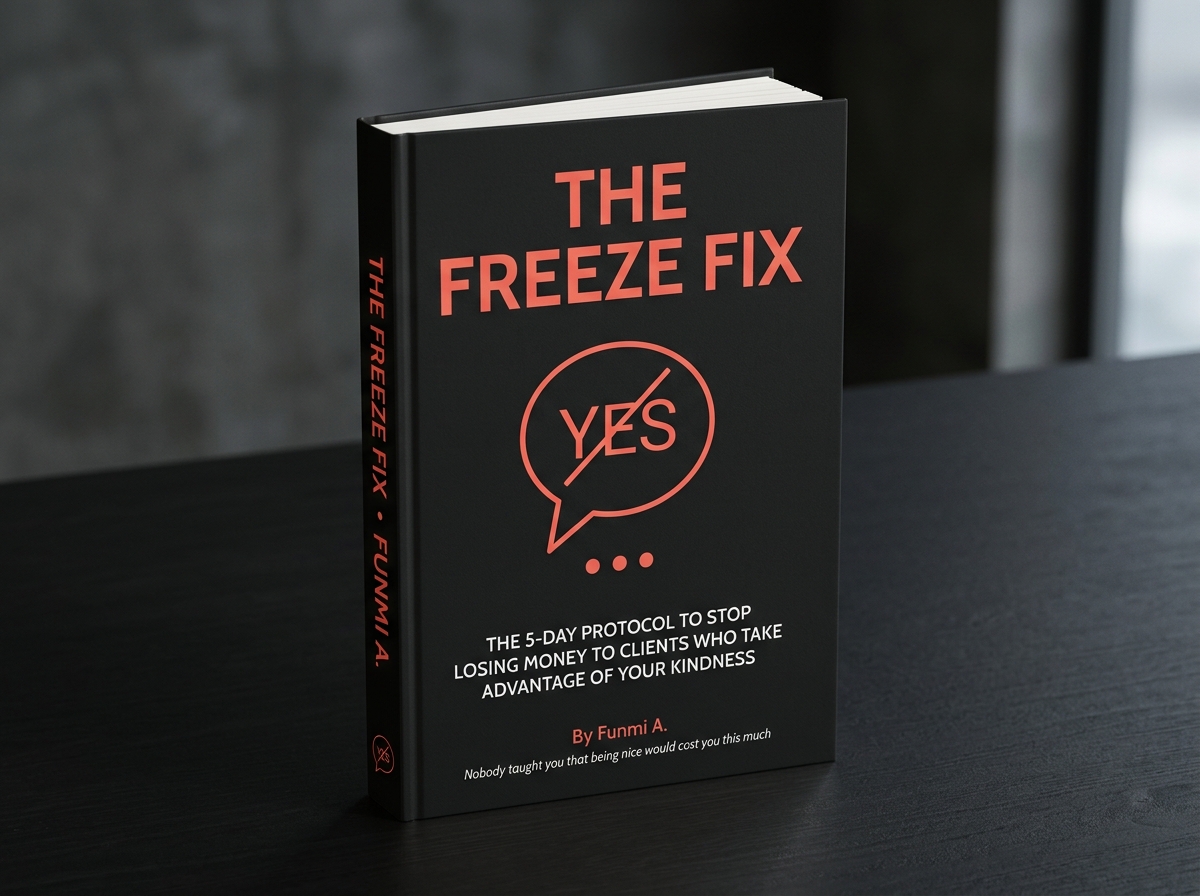
The Freeze Fix
The 5-Day Protocol to Stop Losing Money to Clients Who Take Advantage of Your Kindness
Nobody taught you that being nice would cost you this much. This teaches you how to stop paying.
What's Inside
Day 1: The Price Hold
Word-for-word script for stating your price and holding it when the client pushes back. The internal reframe. The pause that stops the discount reflex.
Day 2: The Scope Lock
How to respond to "can you just add this?" without apologising, over-explaining, or absorbing free work.
Day 3: The Invoice Chase
Follow up on late payments firmly, clearly, in under 3 sentences. No more 45-minute "friendly reminder" emails.
Day 4: The Revision Boundary
"That's outside the included revisions." The framing that makes it professional, not personal.
Day 5: The Freeze
The 3-second pause. The practice that creates space between request and response. Where "yes" becomes a choice.
The Reflex Reframe
Why your "kindness" is actually a childhood survival strategy. The belief driving the reflex. The reframe that transforms fear into genuine kindness with boundaries.
What Other Women Are Saying
"The Day 1 Price Hold recovered N60,000 on my FIRST client call. I quoted. She pushed. I held. She agreed. 4 seconds. I cried at my desk. Not sad crying. The 'I should have done this years ago' crying."
"N350,000 in overdue invoices recovered in 2 weeks using the Day 3 script. Every client paid within days. Not one was angry. They had been waiting for me to ask properly."
"I am a caterer. Clients add last-minute dishes, change menus, increase guests, same price. The Day 2 Scope Lock ended that. The client paused. Then: 'That's fair, send the updated quote.' Two words I had never heard because I had never given anyone the chance to say them."
"The 3-second Freeze changed my entire business. That tiny gap. In that gap, I stopped being the woman who says yes to everything. Revenue up 40% in 2 months. Same clients. Same work. Different boundaries."
"Nigerian woman in London. Raised to be accommodating. The protocol works across cultures because the reflex is the same. Day 1 through Day 5 dismantled the fear systematically. I now quote my rate without apologising."
"I read 'Set Boundaries, Find Peace.' Excellent book. Understood everything. Still couldn't do it. This protocol gave me the WORDS. Not theory. Actual words for the actual moment. Theory doesn't hold a boundary. Scripts do."
Instant download. 14-day guarantee. The discount reflex ends here.
Plus: 2 Bonus Guides
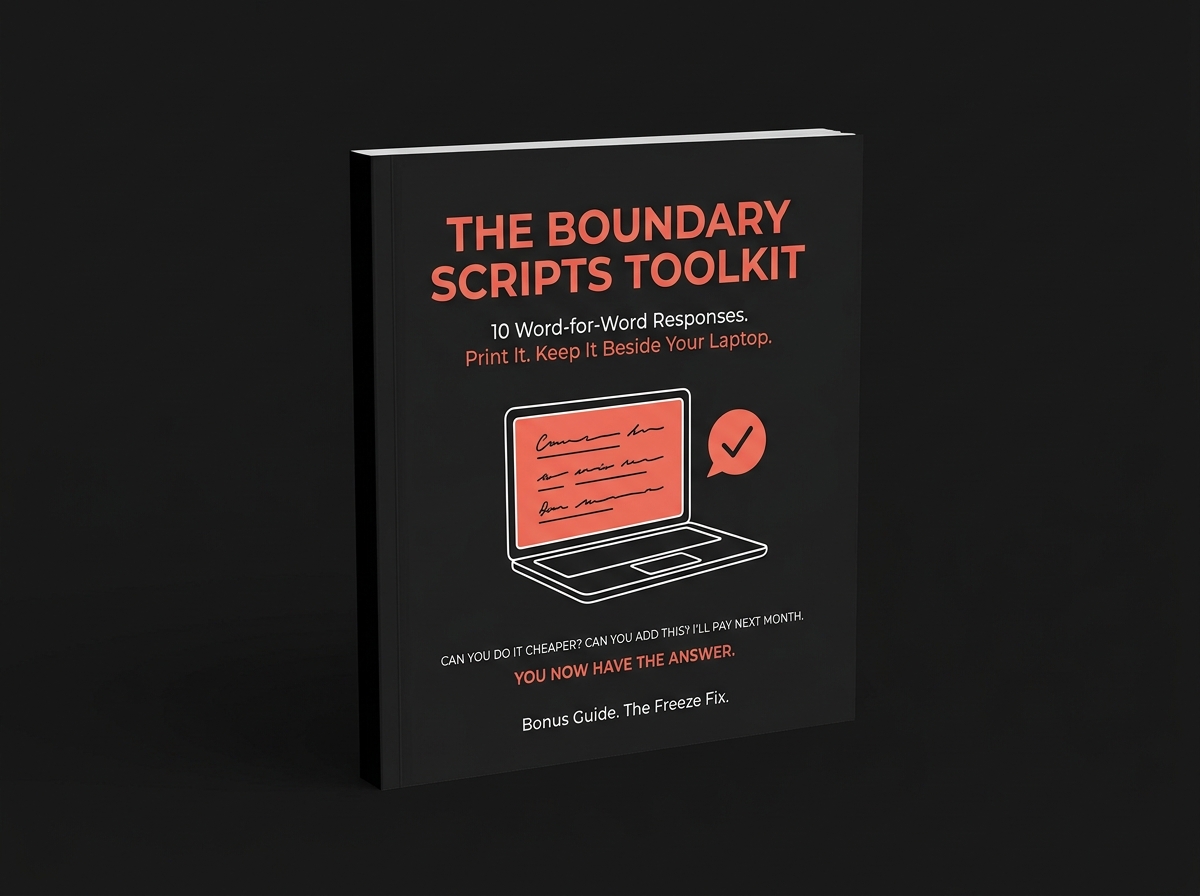
The Boundary Scripts Toolkit
10 most common boundary violations with word-for-word responses. "Can you do it cheaper?" "Can you add this?" "I'll pay next month." Each has a tested response that holds the boundary without damaging the relationship. Print it. Keep it beside your laptop.
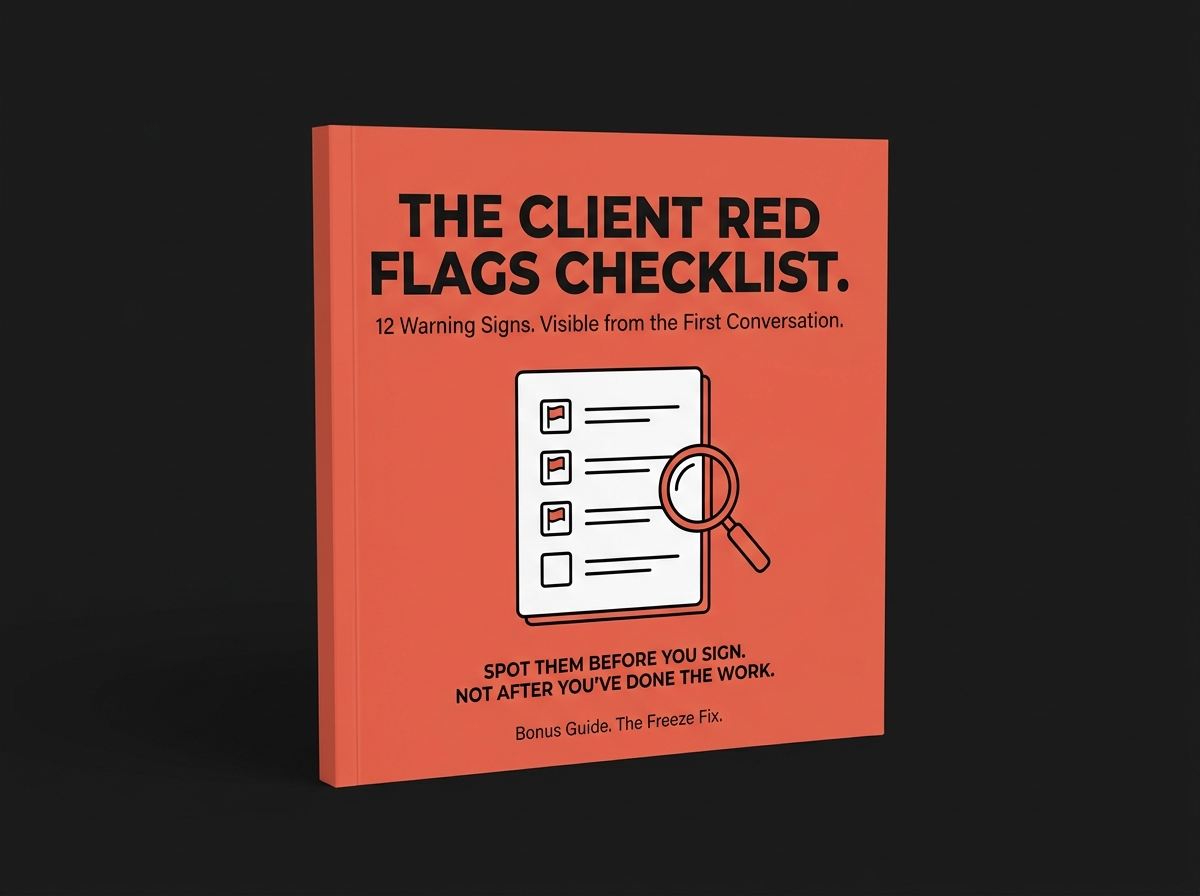
The Client Red Flags Checklist
12 early warning signs a client will exploit your kindness, visible from the FIRST conversation. The client who asks "what's your best price." The one who says "this should be quick" about complex work. Spot them before you sign.
14-Day Money-Back Guarantee
Use the protocol for 14 days. If you don't hold at least one boundary you would have folded on before, full refund. You keep both bonuses regardless.
The reflex either changes or you pay nothing.
Right Now, You Have a Choice
Give the Next Discount
Another client pushes. Another "yes" fires. Another N20,000 vanishes. Another month of 60-hour weeks and N45,000 in the account.
The reflex doesn't fix itself. "Just say no" doesn't work when your nervous system treats "no" as danger.
Learn the Freeze
5 days from now: A client pushes on price. You pause. One. Two. Three. The reflex doesn't fire. You hold. She agrees.
N9,800. 5 days. The boundary held. The money stays. Kind with boundaries is called respect.
P.S. #1: How much did the last discount cost you? The protocol costs N9,800 once. The first boundary you hold pays for it.
P.S. #2: Aunty Bisi: "A woman who is kind without boundaries is not kind. She is afraid. Kindness with boundaries is called respect." N9,800 to stop paying with your fear.