The business courses taught pricing theory that the reflex overrode. The contracts sat unenforced because holding them felt confrontational. The price increases lasted 6 weeks before you discounted back. "Just say no" didn't work because your nervous system treats "no" as danger. Everything you tried addressed the knowledge. Nothing addressed the reflex. You just chose the protocol that addresses the reflex: Day 1 holds the price. Day 2 locks the scope. Day 3 chases the invoice. Day 4 holds the revision boundary. Day 5 installs the Freeze. 5 days. The automatic "yes" becomes a conscious choice.
Kind with boundaries is called respect. For yourself and for the client.
"I am not broken. I am not weak. I learned that being agreeable kept me safe. That compliance earned love. That saying no meant rejection. That strategy kept me safe as a child. As an adult, it is costing me hundreds of thousands of naira per year. The Freeze Fix does not make me less kind. It interrupts the reflex that made kindness a liability. In 5 days, I will hold a price, lock a scope, chase an invoice, hold a revision boundary, and install a 3-second pause that changes everything. The discount reflex ends. The boundary begins. I stay kind. But kind with structure."
Your Complete Protocol Is Ready
Click each button below to download your main guide and both bonus files instantly.
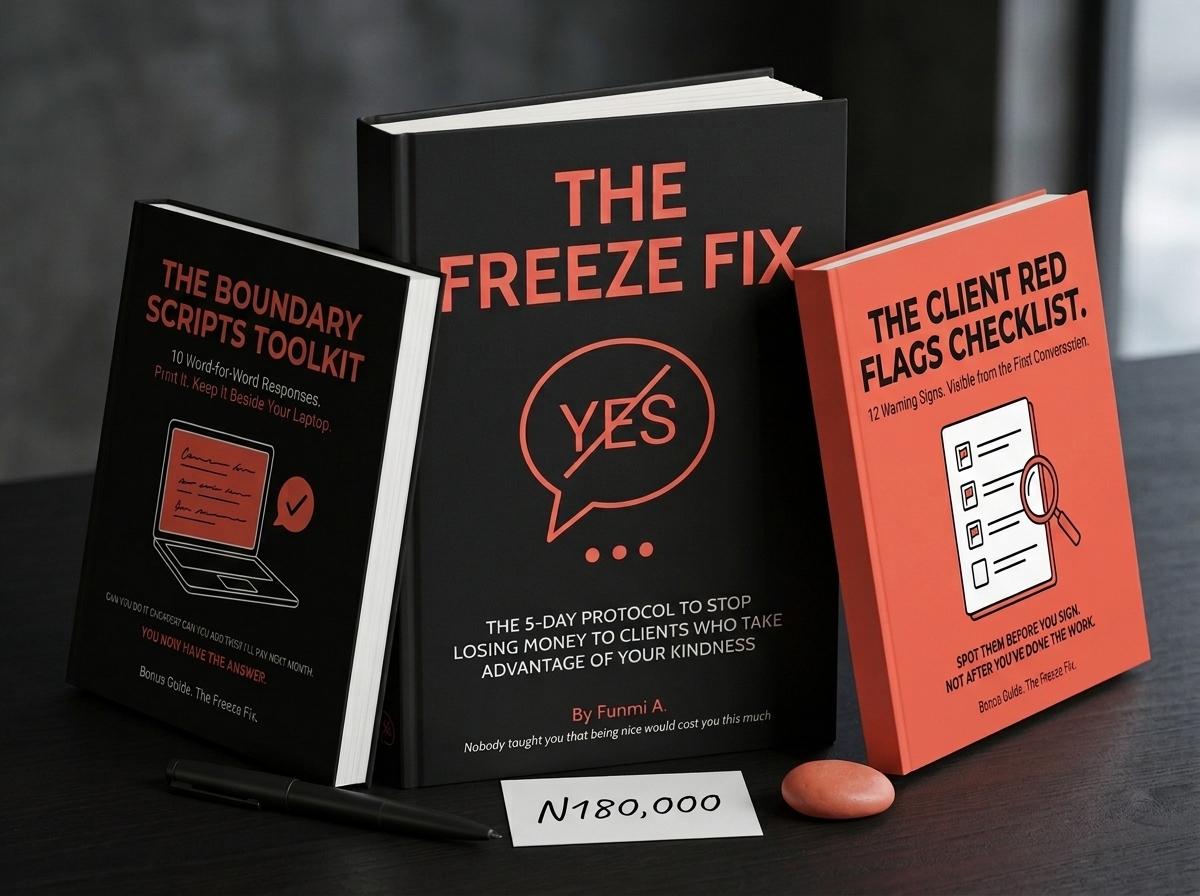
Download Main Protocol Download Bonus 1: Boundary Scripts Toolkit Download Bonus 2: Client Red Flags ChecklistHere's What You Got
Day 1: Price Hold. Day 2: Scope Lock. Day 3: Invoice Chase. Day 4: Revision Boundary. Day 5: The Freeze (3-second pause). Each day has a specific script, a specific practice, and a specific reframe that rewires the automatic "yes" into a conscious choice Download
10 word-for-word responses for the 10 most common boundary violations. "Can you do it cheaper?" "Can you add this one thing?" "I'll pay next month." Print it. Keep it beside your laptop. Use it in real time when the push comes Download
12 early warning signs that a client will exploit your kindness, visible from the first conversation. Spot them before you sign. Not after you've done the work and they're asking for the fourth free revision Download
Your First 48 Hours
Download Everything Now
Tap the buttons above. Save all 3 files. You will use the main protocol starting tomorrow and the Boundary Scripts Toolkit the first time a client pushes back.
Read the Reflex Reframe Section Tonight
Open the main protocol and read pages 3-8: "The Reflex Reframe." This section explains WHY you give the discount before the sentence is finished. It is not weakness. It is a survival pattern learned in childhood that fires automatically in adult professional settings. Understanding WHY the reflex fires is what makes the 5-day protocol work. Without the reframe, the scripts feel like tricks. With it, they feel like liberation.
Print the Boundary Scripts Toolkit (Bonus #1)
Print it tomorrow morning. Put it beside your laptop. You will need it the first time a client asks for a discount, adds scope, delays payment, or requests extra revisions. The scripts are designed to be read in real time. Glance down. Say the words. Hold the line. The script does the heavy lifting while the reflex is still learning to pause.
Read the Client Red Flags Checklist (Bonus #2)
Before your next new client conversation, scan the 12 red flags. You will begin noticing patterns you never saw before: the client who asks your rate and immediately counters, the one who calls the work "quick" or "simple" before seeing the brief, the one who mentions a previous provider they "weren't happy with." These are signals. Once you see them, you cannot unsee them. And knowing what's coming gives you time to prepare the boundary before the push arrives.
Begin Day 1 Tomorrow — The Price Hold
The next time a client asks your rate or you send a quote, you will use the Day 1 protocol. State the price. Hold the pause. If they push, use the Day 1 response script. Your voice may shake slightly. Your heart rate may increase. This is normal. The nervous system is recalibrating. The fear will spike and then subside. And the price will hold. For the first time.
What to Expect
Do This Right Now
Open the Boundary Scripts Toolkit (Bonus #1) and read Script #1: "The Price Push."
This is the response for when a client says "Can we do it for less?" or "What's your best price?" or "That's a bit steep." Read the script. Say it out loud to yourself once. Hear the words in your own voice. Not in your head. Out loud. The physical act of saying the boundary words aloud, even alone, begins rewiring the reflex before the real conversation happens.
Tomorrow, when the push comes (and it will come), you will have already said the words once. They will not be new. They will be familiar. And familiar words come out smoother than first-time words. That smoothness is the difference between a boundary that holds and one that folds.
"The discount reflex fires in under 2 seconds. The Freeze gives you 3. That one extra second is where your income lives."

14-Day Money-Back Guarantee
Use the protocol for 14 days. If you don't hold at least one boundary you would have folded on before, full refund. You keep both bonus guides regardless.
Need Help?
Stuck on a specific client situation? Not sure which script fits? Need to adapt a response for your industry? Woman to woman. Every message answered.